What to ask for instead of a meeting
Hiring a designer in another time zone feels like a risk because the usual way of checking progress is a call. Here is the operating model that replaces it, what to ask for in week one, and the tell that a remote project is drifting.

The worry about hiring a designer on the other side of the world is almost never about skill. It is about the gap.
You have a question at two in the afternoon. They are asleep. You wait. By the time they answer you have moved on, and the answer arrives without the context that made it urgent. Repeat that for six weeks and a project that should have taken six weeks takes ten.
That is a real failure mode. It is also entirely avoidable, and the fix is not more overlap hours.
The overlap window is not the asset
The instinct is to solve a time difference with calendar surgery. Find three hours where both sides are awake, defend them, fill them with calls.
This makes the project worse. Those three hours become the only time anything can be decided, which means every decision queues for them, which means the queue is now the bottleneck instead of the time zone. And the hours you have protected are the end of one person's day and the start of the other's, which is the worst thinking time either of you has.
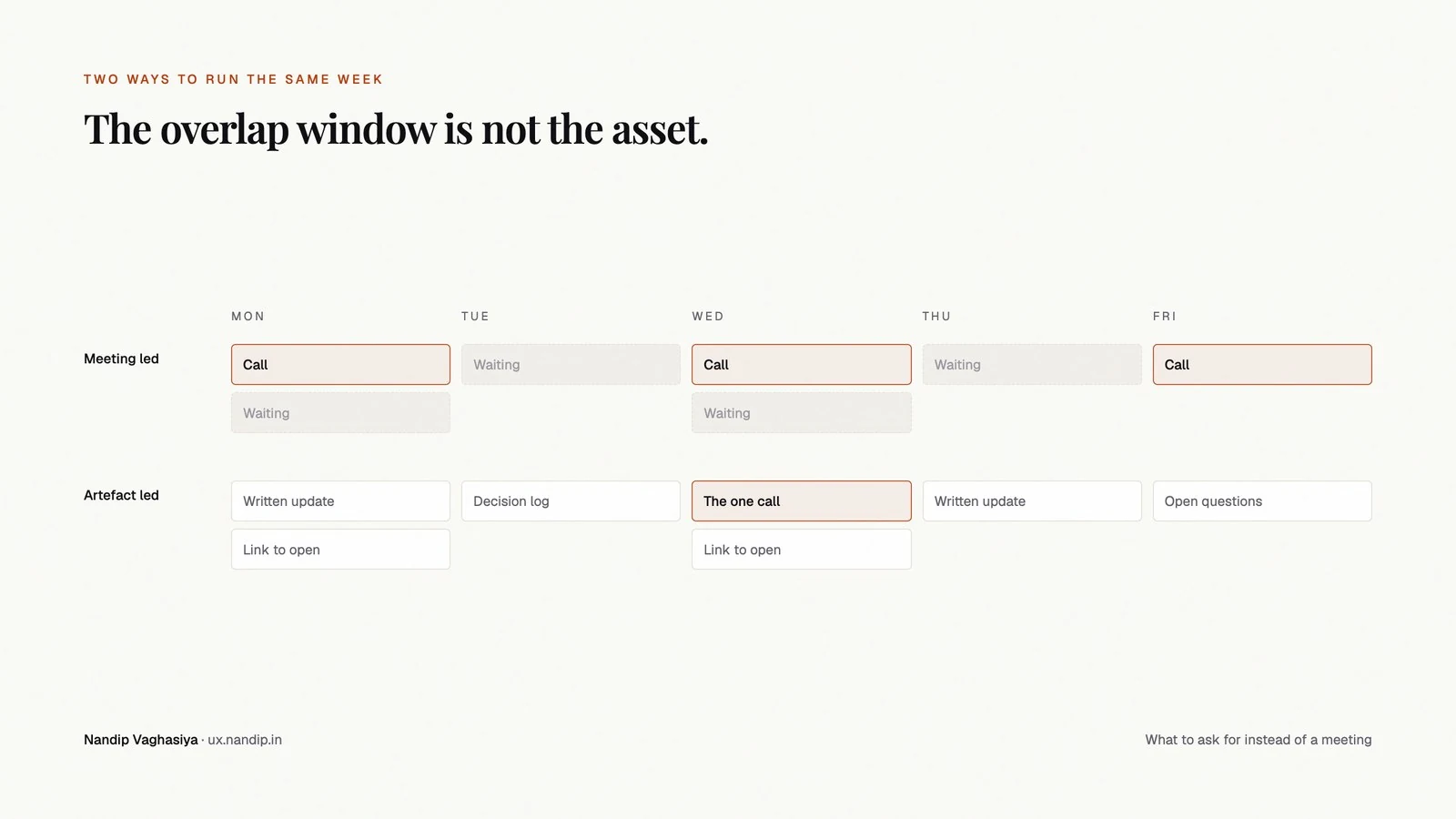
The asset is not the window. It is the artefact. If moving the project forward requires a call, distance is a tax. If it requires opening something and reading it, distance is free parallel time: work happens while you sleep, and you wake up to it.
Everything below is about making the second thing true.
Three things that replace the standup
A written update with the open questions at the top. Not a status report. Status is visible in the work. What a client actually needs is the list of decisions currently blocked on them, stated plainly enough to answer from a phone. Two or three questions, each with a recommendation attached, so the reply can be "yes" rather than an essay.
Something you can open. This is the largest single change. A link that runs in a browser can be reviewed at any hour, by anyone, without the designer present. A screen recording is second best. A meeting where somebody shares their screen and talks over it is the worst option, because the only record of it is everyone's memory, and those will differ.
A decision log. One list, most recent at the top, of what was decided, when, and why. It takes about five minutes a week to keep. It ends the single most expensive conversation in remote work, which is the one six weeks later that begins "I thought we agreed".
The one meeting worth keeping
One a week, at a fixed time, thirty to forty-five minutes, with an agenda that was written before it started.
It is not for status. It is for the things that genuinely need tone of voice: disagreement, ambiguity, the moment somebody is unhappy and will not say so in writing. Those are real, and they do not survive being written down.
If a week has none of that, the meeting should be cancelled rather than filled. A weekly call with nothing in it trains everyone to stop preparing for it.
What goes wrong, and how you will know
Async work fails quietly. There is no shouting match, just a slow divergence where both sides believe they are aligned and are not.
The tell is specific and worth watching for: the updates stop containing questions.
An update that is all progress and no questions looks great and is a warning. It means one of three things. The designer has stopped hitting decisions, which means they have stopped doing the hard part. Or they have started guessing your answers, which means you are about to receive something you did not ask for. Or they have decided asking is not worth the delay, which is the most expensive one, because it means the process taught them that.
Good remote work generates a steady trickle of small, specific questions. That trickle is the sound of a project staying on the rails.
What to ask for in week one
Before any of the design work matters, these four things tell you whether the next two months will be calm or exhausting.
- A link you can open, in the first week. Rough is fine. Ugly is fine. What matters is that reviewing it never requires an appointment.
- The questions they think are still open. Anyone who has none in week one has not understood the problem yet.
- Where decisions will be recorded, and then actually read it after a fortnight. If it has not been updated, it will not be updated later either.
- What they need from you, and by when. A designer who cannot tell you what they are blocked on will be blocked silently.
None of that is about time zones. It is what good practice looks like anywhere, and distance just removes the option of getting away without it.
The upside, once it works, is real. Ten hours of separation means a question asked at the end of your day has an answer waiting at the start of the next one. You are not waiting on each other. You are handing the work back and forth.
If you want to see the artefact half of this, the prototypes are here, and the case studies are the written half.