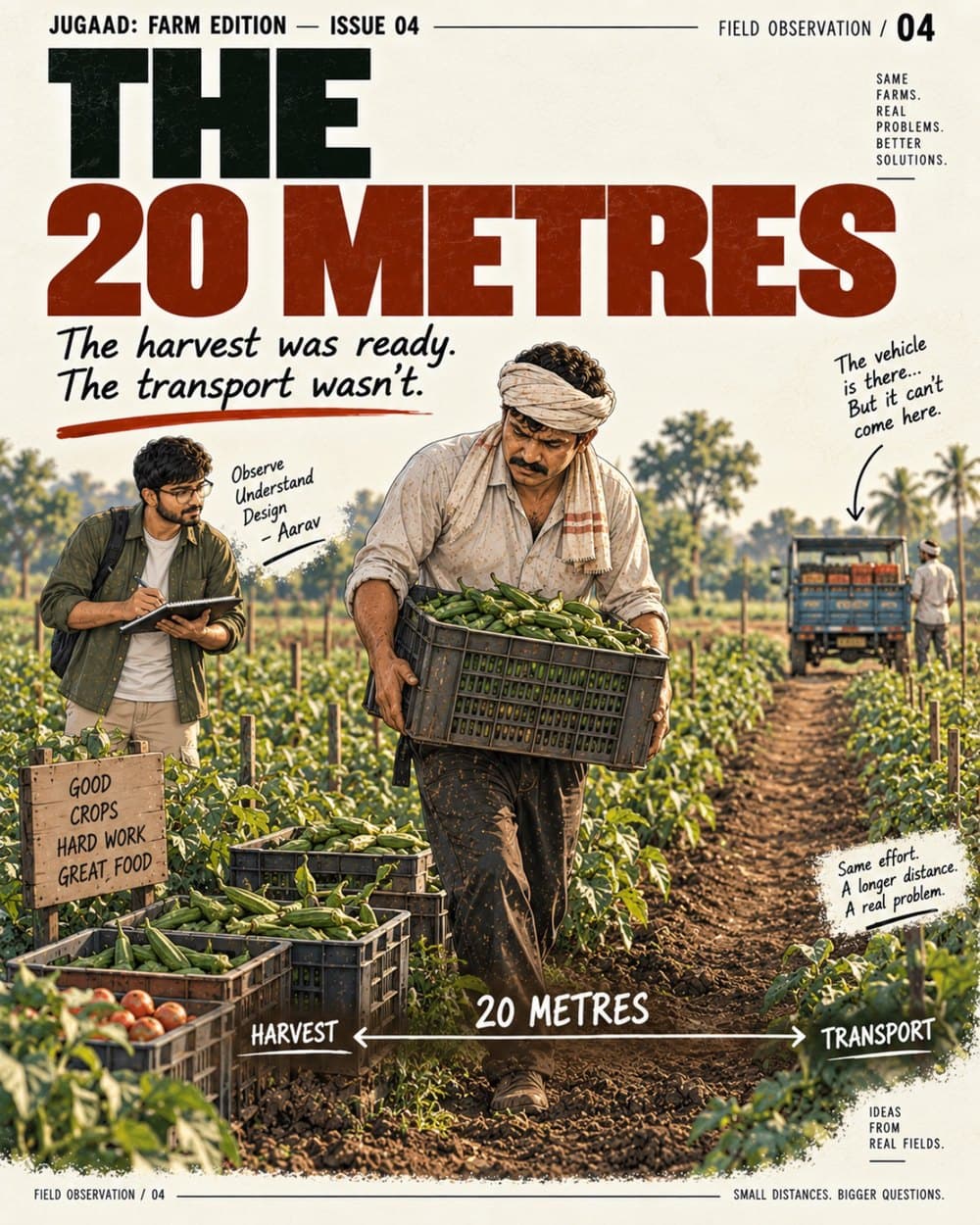
The 20 metres
The distance from the row to the truck was never the problem. Changing containers was. Field Dock turns the harvest box into the cart, so produce is loaded once and rolled away.
- Self-directed field study
- Field research, industrial design, prototyping
- 8 September 2026
- 3 min
Watch first
The cart was not the problem.
The harvest happens in the row. The transport is twenty metres away, at the field edge. In between, small containers fill quickly, get carried across narrow rows and uneven ground, and are then emptied into a larger crate that goes onto the vehicle.
Same produce. New container. Another trip back.
The farmer was not transporting produce. He was transporting containers.
Then I followed the box
It was not the distance. It was the handoff.
Traced end to end, one day's journey ran: field, temporary basket, farmer's hands, larger crate, transport cart. Five stages, and the produce was lifted and poured at nearly every one. Every transfer costs time, and soft produce pays for it twice, once in effort and once in damage.
So the question became simple: why change containers at all?
Don't move the harvest between boxes. Move the same box.
A harvest container plus a transport interface is one workflow, not two.
The solution
Field Dock is a ventilated harvest box that clicks onto a wheel frame, so the box that gets filled is the box that travels.
- A ventilated harvest box, narrow enough for crop rows and light to work with
- Side docking rails on both sides
- A quick-lock spring-loaded pin, self-centring, one click
- A foldable, removable wheel frame
- Field handles for comfort, and an optional pull handle for longer distances
The box became the cart. The transport frame is only the interface.
What changed
Before: harvest, temporary storage, transfer, large crate, cart. Two containers and a manual pour in the middle.
After: harvest into the box, dock, roll. One container, from the row to the vehicle, with no emptying and no extra handling.
The best way to move the harvest was to stop moving the harvest between boxes.
What I ruled out
A wheelbarrow. The default answer, and it keeps the transfer. Produce still moves from the picking container into the barrow, which is the handling the study was about.
One larger box. Fewer trips, and it becomes too heavy to lift at the end, which turns a walking problem into a lifting problem.
A trolley you load boxes onto. Sensible in a warehouse. In a field it means lifting a full box up onto a platform, which is the single heaviest movement in the whole sequence.
What already exists
Crate dollies and platform trolleys solve this indoors, on flat floors, in warehouses and markets. The mechanism is not the hard part.
The field is the hard part: uneven ground, soft soil after irrigation, and rows narrow enough that anything wide cannot enter. That is why the warehouse answer has not simply been carried across.
What I have not tested
Wheel behaviour on soft ground, which is the thing most likely to sink this. Also untested: stability when the box is full and the ground slopes, whether the click fitting survives grit, and how it handles being pulled rather than pushed.
What I would do next
Take it onto wet soil. Dry-field performance would prove very little. Irrigated ground a day after watering is the honest test.
Count transfers, not minutes. The claim is that the produce is handled once. That is countable, and it is a better argument than a time saving I have not measured.