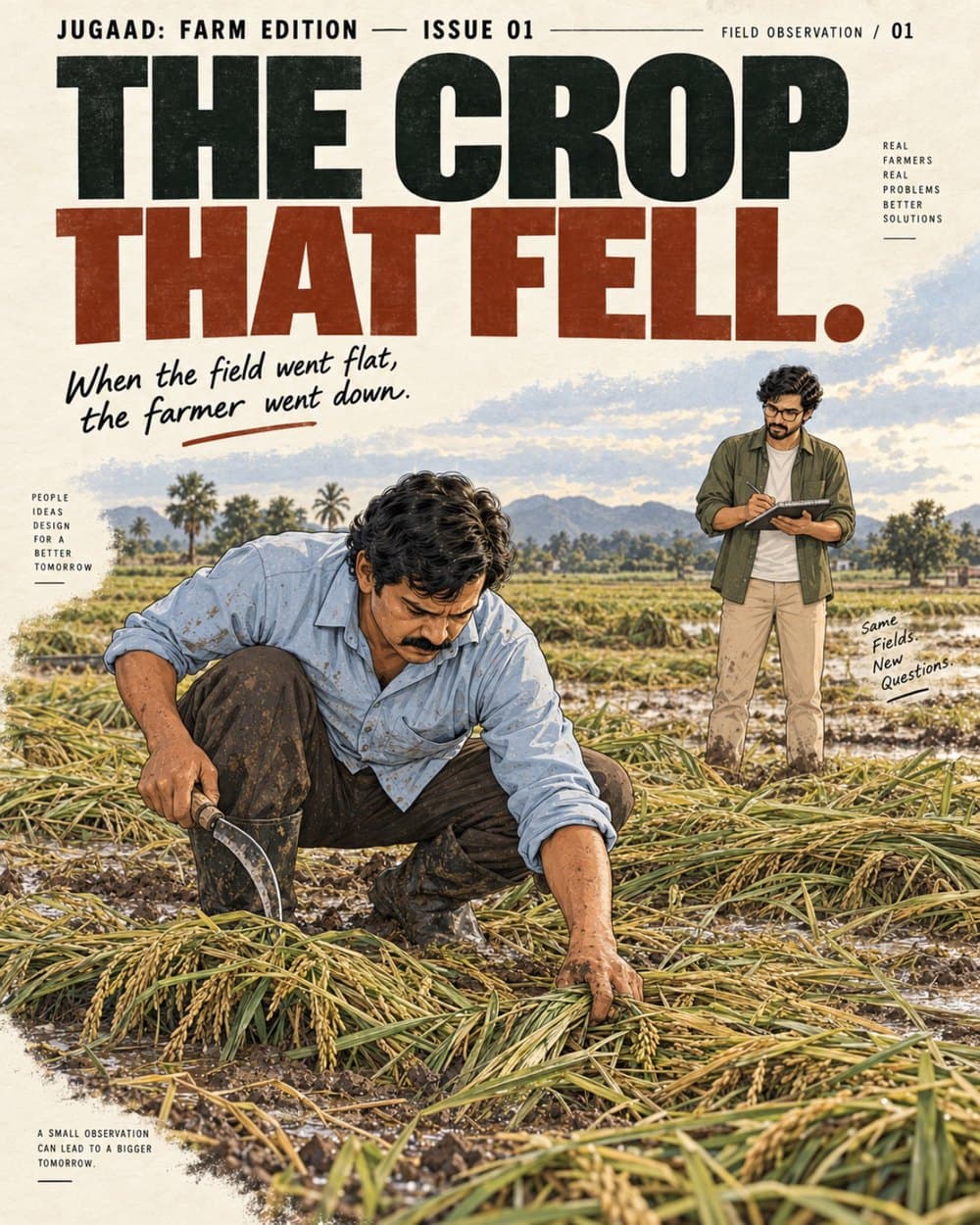
The crop that fell
After a storm flattens a field, harvesting stops being a cutting job and becomes a lifting job. Lodge-Lift raises fallen crop ahead of the blade so the work happens standing up.
- Self-directed field study
- Field research, industrial design, prototyping
- 18 August 2026
- 4 min
Watch first
After the storm the crop was still there. It just was not where it was supposed to be. Lodged flat against the soil, a field that should have taken a morning turned into a day spent on hands and knees.
I watched the movement before looking at the tool. Every bundle started the same way:
Bend, find, grab, lift, cut, move. Then bend again.
A few steps later, the same thing. The sickle was fine. The cut was fine. The farmer was spending the day lifting, not cutting.
The problem was not the cut. It was the lift.
Then I asked a different question
The obvious brief is a better blade. The useful question was different: why should the farmer lift the crop at all?
The farmer was already walking forward. That forward motion was free energy nobody was using. If something else could do the lifting, the posture of the whole job would change.
Don't make the farmer go down. Make the crop come up.
Design principle: use forward motion to create the lift.
The solution
Lodge-Lift is a simple wheeled frame that slides under lodged crop, raises it and gathers it to a comfortable cutting height.
- Field wheels, rugged, for the forward motion that does the work
- Low-profile lifting fingers that enter under a flat crop
- A curved crop cradle that lifts and holds the stems together
- A simple lift lever and an ergonomic handle
There is no motor and no complexity. The push is the mechanism.
What changed
The old workflow was seven movements on the ground: bend, find, grab, lift, cut, move, bend again. The new one is four, standing: push, lift, cut, move.
The same field, the same sickle, the same person. A different posture.
The farmer did not need a better sickle. He needed the crop to come up.
What I ruled out
A better blade. The obvious brief, and the whole point of the study is that it answers the wrong question. A sharper sickle makes the cut faster. The cut was never the slow part.
A powered lifter. It would work. It also needs fuel, a place to charge or refill, and somebody who can fix it when it stops in the middle of a field. On a plot this size, a mechanism that can fail in a way the owner cannot repair is worse than no mechanism.
A hand hook to raise the crop. Cheaper and simpler than what I drew, and it keeps the farmer bent over. It speeds up the movement that should not be happening at all.
What already exists
Crop lifters are not new. Combine harvesters have them, and they solve exactly this problem at machine scale: fingers that slide under lodged crop and raise it into the header.
What does not exist is the version for someone harvesting by hand on a small plot. The engineering is solved; the scale it is solved at is the wrong one. That gap is the whole opportunity, and it is worth saying plainly rather than implying I invented the principle.
What I have not tested
This is a concept from field observation, not a product that has been built and trialled. I have not measured how it behaves on wet soil against dry, whether the fingers ride over or dig into different soil types, how it copes with crops lodged in more than one direction, or what it costs to make.
What I would do next
Build one and put it in a field. Everything above is reasoning from watching one harvest. The first prototype would answer more than another month of drawing.
Measure bundles per hour, not comfort. Posture is the argument, but the number that would convince a farmer is how much of the field gets cut before dark.