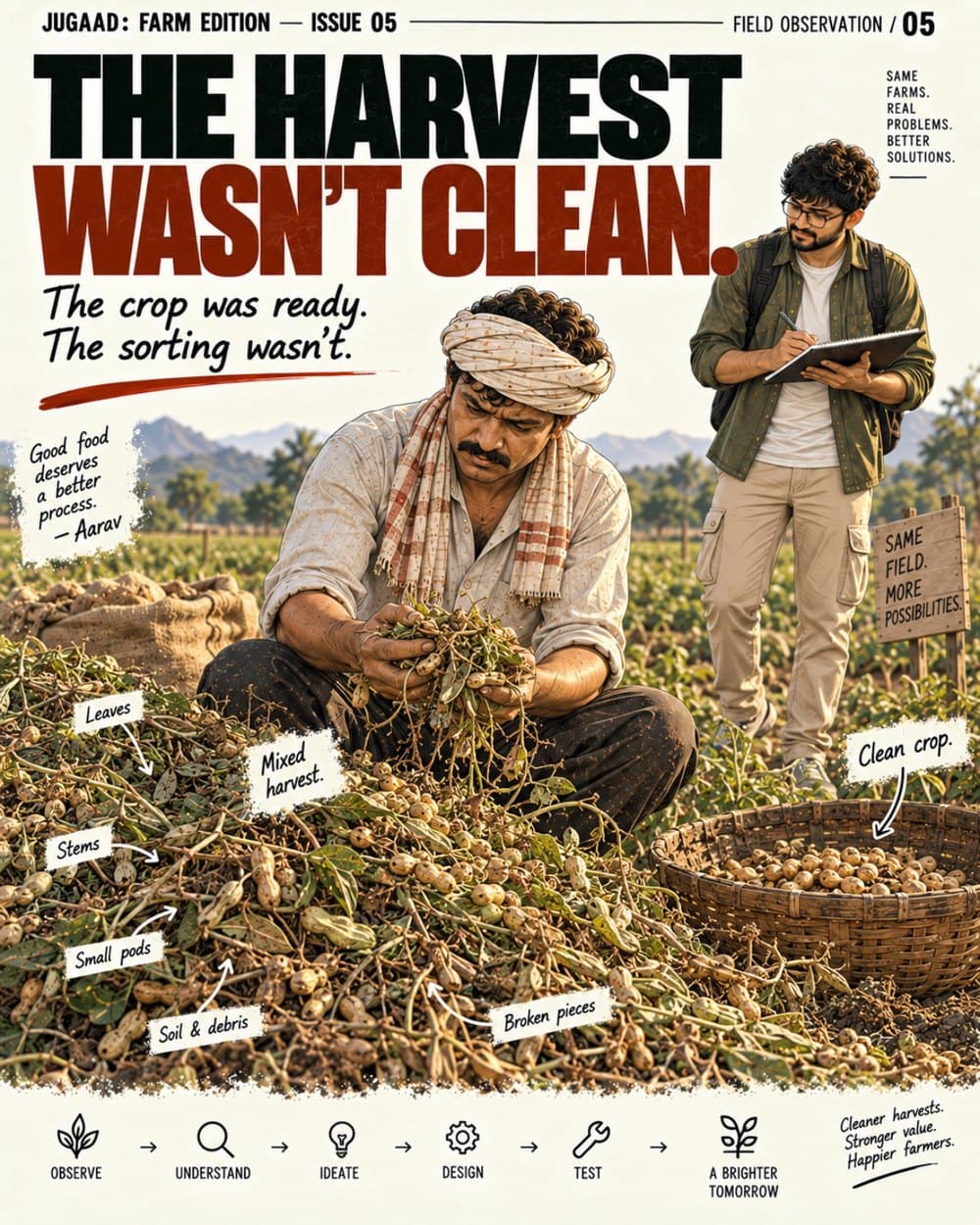
The harvest wasn't clean
When the digging stops, the sorting starts. Crop Gate uses the way different materials already move to separate groundnut from leaves and stems, so the crop sorts itself.
- Self-directed field study
- Field research, mechanism design, prototyping
- 15 September 2026
- 3 min
Watch first
The harvesting ended. The work did not.
Digging creates a pile: crop, leaves, stems, soil and small debris together. What follows is done by hand, sitting next to it. Look, pick, check, shake. Remove leaves, remove stems, keep the crop. Then do it again, because one pass is never enough.
Mix, sort, sort again, clean. Three passes over the same material.
The second job started after the first one ended.
Then I stopped sorting
Watching the pile rather than the hands changed the problem. Different materials were already behaving differently on their own:
- Heavier crop pieces roll and travel further
- Light leaves slow down and drift sideways
- Long stems catch on things
- Small debris falls through gaps
Nobody was using any of that. The hand was overriding physics that was already doing most of the separation for free.
Don't sort it with your hands. Let the material sort itself.
Design principle: use natural differences in movement.
The solution
Crop Gate is an inclined tray that gives each material a different path.
- A receiving tray with side walls, poured into by hand
- A smooth inclined sheet-metal surface, so gravity does the work
- Flexible rubber guide ribs that redirect stems aside while crop continues
- An adjustable gap on a sliding plate, set narrower or wider for small, medium or large crop
- A crop collection pocket, a residue side channel, and a simple sturdy frame
Simple parts, local materials, easy to build and easy to repair.
What changed
Before: mix, hand sort, hand sort again, clean. After: pour, guide, separate, collect.
Less picking, more collecting. Clean crop into one bag, residue into another, in a single pass.
The farmer did not need to sort faster. The material just needed different paths.
What I ruled out
A powered screen or blower. It works, and it needs power in a field, plus a repair path when it stops. The same objection as every motorised answer on a small plot.
A rotating drum separator. Effective at scale and rough on the crop. Groundnut shells crack, and a cracked pod is a downgraded one.
Sorting by hand, faster. Worth stating because it is the honest baseline. People are already good at this. The problem is not that they are slow, it is that the job exists at all after a day of digging.
What already exists
Gravity separators and de-stoners do exactly this industrially, and winnowing is the traditional version of the same physics: let different materials behave differently and collect them separately.
Neither serves the middle. Industrial machines assume volume and power; winnowing assumes wind and patience. This sits between them, which is a gap rather than a new idea, and it should be described that way.
What I have not tested
The separation rate, and more importantly the loss rate. An inclined tray that removes debris beautifully while sending five percent of the pods out with it is not a good tool, and I do not yet know which side of that line this falls on.
Also untested: how it copes with damp material, which sticks, and with soil still clinging to pods.
What I would do next
Weigh what comes out of the waste side. That single number decides whether this is worth building. Everything else is secondary to it.
Test damp, not dry. Dry, loose material is the easy case, and it is not the one that happens at the end of a real digging day.