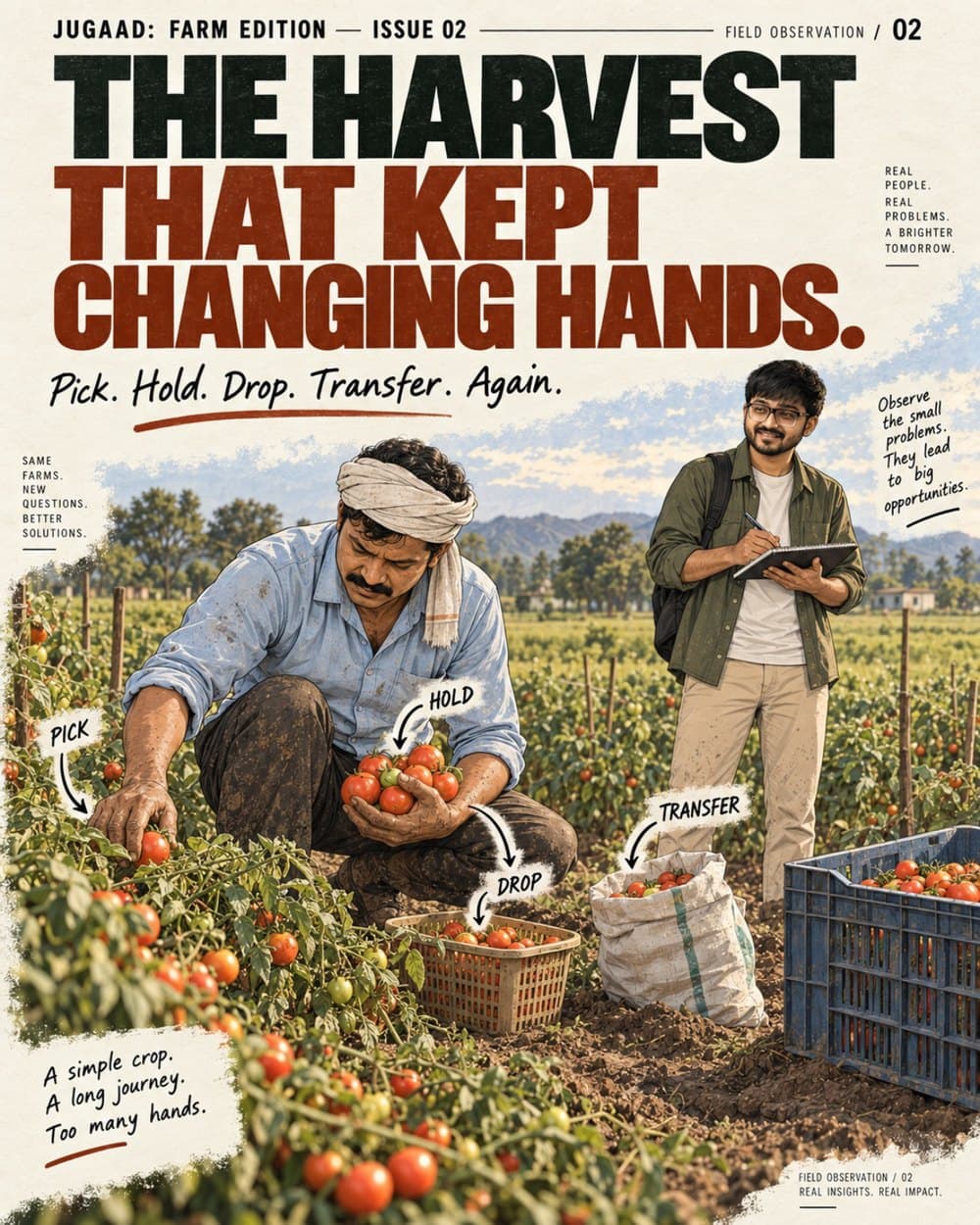
The harvest that kept changing hands
Picking tomatoes was never the slow part. The slow part was everything after. Harvest Bridge brings the container into the harvest path so produce is handled once instead of three times.
- Self-directed field study
- Field research, industrial design, prototyping
- 25 August 2026
- 3 min
Watch first
Picking was not the problem. The awkward part happened after the picking.
Watch a hand through one cycle and the shape of the day appears:
Pick. Hold. Search for the container. Drop. Return to the crop.
Then, at the end of a row, the basket is emptied into a crate. The same produce gets handled again. Soft fruit does not improve with handling.
The harvest was being handled more than once.
Then I followed the hand
It was not about carrying produce. It was about where the hand had to go next.
For every single piece, the hand travelled crop → body → basket → body → crop. A long path, repeated a few thousand times a day. The container was sitting still, and the person was doing all the moving.
Don't make the farmer reach for the container. Bring the container into the harvest path.
The solution
Harvest Bridge is a worn receiving funnel that feeds a removable box, so the picked fruit never waits in a hand.
- A soft, wide receiving funnel with a large opening, so aim does not matter
- A flexible low-friction chute where gravity does the transfer
- A gentle curved landing surface, because delicate produce bruises
- A ventilated removable harvest box that goes from field to market
- A quick-release box mount and an adjustable waist and hip support
What changed
Before: pick, hold, find basket, drop, transfer, pick again. After: pick, drop, continue.
One hand picks. The other stays free. The box that catches the fruit is the box that travels, so there is no single-fruit transfer at any point.
The best harvesting tool did not make picking faster. It removed the extra step.
What I ruled out
A bigger basket. It holds more and it still sits on the ground, so the reach that costs the time is unchanged. More capacity, same movement.
A shoulder bag. Keeps the container with the picker, which is right, and it presses fruit against the body. For tomatoes that is bruising, and bruised fruit is worth less at sale.
A cart that follows down the row. Good where rows are wide. On the plots I watched they are not, and a cart that cannot fit between rows becomes another thing to walk to.
What already exists
Orchard picking bags solve this for apples: the container travels with the picker and empties from the bottom. The pattern is proven.
It has not moved to low-growing crops, where the picking height is at the knee rather than overhead, and where a bag hanging at the front is in the way of the plant. The idea transfers; the shape does not.
What I have not tested
Whether people will wear it. That is the real risk, and it is not a drawing problem. Also untested: how heavy it gets before it stops being comfortable, whether the funnel bruises fruit on the way down, and how it behaves when the crop is wet.
What I would do next
Bruise test first. If fruit arrives damaged, nothing else about the design matters. That is one afternoon and a set of scales.
Find the weight where people take it off. There will be a point where the full box makes it worse than walking to a basket. The design has to stay under that, and I do not yet know where it is.